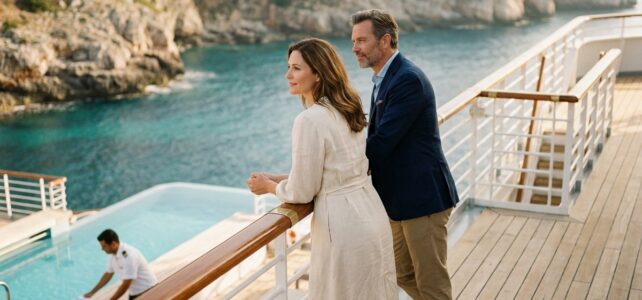
Comparing luxury cruise lines often amounts to reading lists of brands without a framework for understanding. The crew-to-passenger ratio, ship size, fare inclusions, and environmental policies vary significantly from one operator to another. It is these measurable differences that determine whether a luxury cruise lives up to its promises or is merely a cosmetic upgrade.
Crew-to-passenger ratio and ship size: what brochures don’t compare
The first reliable indicator of the level of service on board remains the ratio of crew members to passengers. On ships from contemporary companies, this ratio hovers around one crew member for every three passengers. Premium lines like Oceania Cruises or Celebrity Cruises are a step above, while ultra-luxury operators (Silversea, Seabourn, Regent Seven Seas) achieve a ratio close to one-to-one.
This figure directly influences the responsiveness of butler service, the smoothness of dining experiences, and the ability to personalize shore excursions. A ship with fewer than 600 passengers and a high ratio offers a radically different experience from a cruise ship carrying several thousand travelers, even if both claim to be “luxury.”
| Criterion | Premium Company | Ultra-Luxury Company |
|---|---|---|
| Typical ship capacity | 1,200 to 2,500 passengers | Fewer than 600 passengers |
| Crew-to-passenger ratio | About 1 to 2 | Close to 1 to 1 |
| Suites with balcony | Upper categories only | Majority or all cabins |
| All-inclusive formula | Partial (drinks, tips extra) | Complete (drinks, excursions, Wi-Fi, tips) |
| Specialty restaurants | At extra charge | Included at no extra cost |
Among the newer companies in this segment, Explora Journeys positions itself with human-sized ships, suites exclusively with private terraces, and a formula encompassing the majority of onboard services.
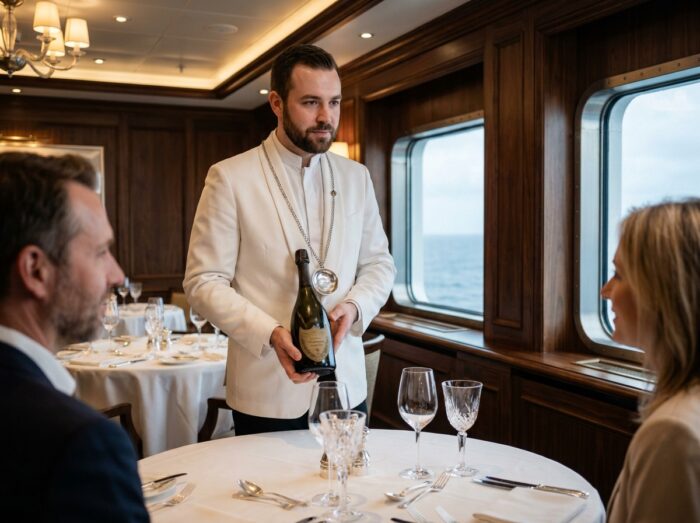
Luxury expedition cruise: reinforced ships and polar itineraries
Going on a cruise differently, for the past few years, also means leaving the Mediterranean and the Caribbean for itineraries in the Arctic, Antarctic, or sub-Antarctic regions. Several high-end companies (Ponant, Silversea, Seabourn, Scenic) have invested in hybrid or ice-strengthened icebreaker ships, capable of reaching areas inaccessible to traditional cruise ships.
These expedition ships retain the codes of luxury (refined gastronomy, spa, spacious suites) while carrying teams of naturalists, geologists, or marine biologists. The journey is not limited to cabin comfort: it includes zodiac outings, scientific lectures, and guided wildlife approaches.
The gap with a classic cruise also lies in the size of the deployed fleet. High-end expedition ships rarely carry more than 200 passengers, which reduces the impact on fragile ecosystems and allows for stops in ports or sites without tourist infrastructure.
- Ponant operates an expedition fleet positioned in polar regions, with reinforced hulls and scientific support on board.
- Silversea offers itineraries combining expedition and ultra-luxury, with butler service maintained even in remote areas.
- Seabourn has launched ships specifically designed for polar waters, incorporating observation submarines for passengers.
Environmental constraints of the IMO and impact on luxury itineraries
The implementation of the Carbon Intensity Indicator (CII) and EEXI requirements by the IMO in 2023 is significantly changing the offerings of luxury cruise lines. These regulations require operators to reduce their emissions per nautical mile traveled, leading to two visible adjustments for passengers.
The first: a reduction in cruising speeds. Slower navigation consumes less fuel and improves the ship’s CII rating. For premium companies, this is both a commercial argument and a constraint. “Slow cruising” becomes an intentional positioning, with longer crossings, more time at sea, and fewer ports per week.
The second: a reorganization of itineraries to avoid the most congested ports. Stops in alternative destinations (secondary ports in the Mediterranean, less frequented fjords in Scandinavia) help reduce consumption related to port maneuvers and offer more exclusive experiences to travelers.
Some companies are also investing in cleaner propulsion technologies: LNG, biofuels, energy optimization systems. These investments are reflected in cruise prices, but they partly explain why the high-end segment attracts passengers sensitive to the environmental impact of their travel.
Slow cruising and cultural immersion: fewer stops, more depth
The trend toward slow cruising is not just a regulatory constraint. It corresponds to a growing demand from travelers who prioritize immersion over the accumulation of stops. Staying two days in a port instead of a few hours allows for in-depth excursions: visits to local markets early in the morning, hikes in the countryside, meetings with artisans.
Companies like Ponant or Silversea now integrate cultural immersion programs designed with local partners, which go beyond the classic guided tour. These programs sometimes include dinners with locals, regional cooking workshops, or outings with local naturalist guides.
- The time spent at each stop increases, with overnight stays in port on certain high-end itineraries.
- “Private” excursions in small groups are gradually replacing coach outings for 40 people.
- Itineraries include stops in destinations without traditional cruise terminals, accessible only by tender.
This model relies on low-capacity ships. Beyond 300 passengers, the logistics of personalized excursions become difficult to maintain without sacrificing the quality of supervision.
Ultimately, the choice of a high-end company is reflected in three concrete data points: the crew-to-passenger ratio, the ship’s capacity, and the average number of hours spent at each stop. These three parameters, rarely highlighted in brochures, separate a premium cruise from a journey that truly transforms the way to discover a destination by sea.