
Organizing a wedding involves dozens of interconnected decisions over several months, sometimes more than a year. Choosing the venue, coordinating vendors, budgeting, and logistics for the big day: each aspect interacts with the others, and a delay in one often pushes everything else back. Before diving into lists and schedules, it’s worth understanding where the real friction points lie.
Secure the reception venue before any other decision
Most guides recommend setting a budget first. In practice, the reception venue dictates almost everything else: guest count, type of caterer, accessibility, accommodation, and even the wedding date.
The most sought-after venues are often fully booked months in advance, sometimes over a year for summer weekends. As long as the venue is not reserved, the budget remains theoretical, because the “venue + catering” line item often represents the largest portion of expenses. A couple finding practical information on Passion Mariage can gauge the extent of the parameters to align before even contacting a first vendor.
Visiting at least three different venues allows for comparison not only of prices but also of logistical constraints: allowed noise hours, on-site kitchen or the need to hire an external caterer, parking, accessibility for people with reduced mobility. These details, rarely visible in photos, change the game on the big day.
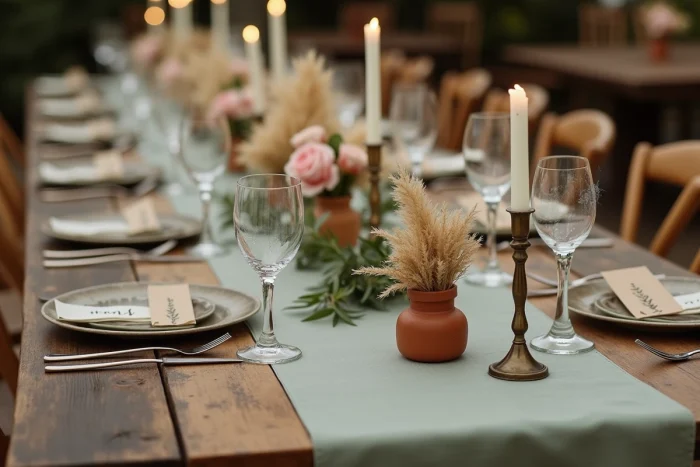
Wedding budget: prioritize line items rather than set a global cap
Setting a total amount and then dividing it into percentages is the most common method. It has a limitation: not every budget item compresses in the same way. Reducing the guest count mechanically lowers catering, tableware, drinks, and sometimes the size of the venue. Cutting back on decoration or stationery only yields marginal savings.
For a wedding with a tight budget, the most effective levers are not very spectacular:
- Choosing a date outside the high season (May to September), which reduces venue costs and competition among couples for the same vendors.
- Holding the ceremony on a weekday when some venues offer significantly lower rates than on weekends.
- Limiting the guest list to a small circle, as the number of guests remains the primary cost multiplier.
A couple that starts by listing what truly matters to them (live music, quality of the meal, a specific photographer) can reallocate the budget towards these items and accept compromises elsewhere.
Wedding vendor selection: what quotes don’t show
Caterer, photographer, DJ or band, florist, officiant for the civil ceremony: the list quickly grows. Feedback on this point varies, but one observation often recurs: price alone does not predict the quality of service.
Two criteria deserve more attention than the displayed price. The first is the vendor’s responsiveness during the quoting phase. A professional who takes three weeks to respond before the wedding is likely to cause coordination issues on the big day. The second is the consistency between the vendor’s style and the desired atmosphere. A photographer specializing in spontaneous reportage will not produce the same images as a photographer focused on classic poses, even at an equivalent price.
The contract, a often overlooked line of defense
Each service should be covered by a written contract specifying the exact scope (number of hours, deliverables, deadlines), cancellation conditions, and payment terms. The absence of a contract exposes parties to disagreements without clear recourse. This point seems obvious, but a significant portion of post-wedding disputes arises from verbal agreements that were never formalized.
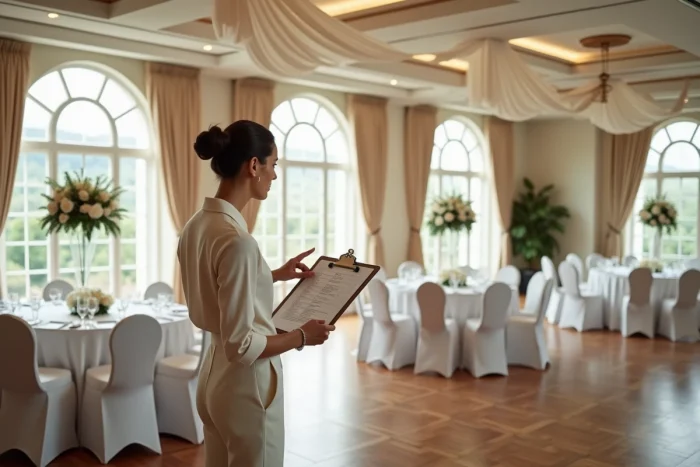
Wedding decoration and theme: start from constraints, not inspiration
Inspiration platforms (with Pinterest at the forefront) showcase highly staged weddings, often executed with substantial decoration budgets. Starting from an ideal image and then trying to replicate it frequently leads to disappointments or budget overruns.
The opposite approach works better: start from the actual venue, its materials, its natural light, and then build the decoration around what already exists. A venue with exposed beams and stone does not need the same dressing as a municipal banquet hall. The most successful decoration extends the venue rather than masking it.
Choosing a wedding theme primarily helps in making quick decisions: colors, flowers, stationery, attire for the witnesses. Without a guiding thread, each choice starts from scratch. With a simple theme (a palette of two or three colors, a botanical universe, an era), the trade-offs become smoother.
Day-of planning: the safety margin that no one anticipates
The minute-by-minute schedule for the wedding day is often constructed as tightly as possible: ceremony at this time, cocktail at that time, dinner at this time. The problem is that almost every step takes longer than expected.
The preparation of the couple often overruns. The journey between the town hall and the reception venue depends on traffic. Group photos with family can easily take twice the allotted time. Allowing a margin of at least thirty minutes between each time block prevents a domino effect on the rest of the day.
Designating a trusted person (a witness, an organized friend, or a wedding planner) as the logistical relay on the big day allows the couple not to manage delays, deliveries, or vendor questions themselves. This coordination role is probably the most underestimated in wedding planning.
A well-organized wedding is not one where everything goes exactly as planned. It is one where the unexpected has been anticipated within the very structure of the schedule, and where decisions made in advance leave enough flexibility to enjoy the day.