
The market for vintage fashion magazines does not operate like that of rare books. An issue of Vogue can sit in an attic for decades without increasing in value, then sell for a surprising price at a specialized auction. What separates a mundane copy from a sought-after piece lies in a few specific variables, often misunderstood by casual sellers.
Professional Demand and Condé Nast Archives: An Overlooked Price Factor
Private collectors are not the only buyers in this market. The Condé Nast Archive and licensed image databases occasionally buy or rent physical copies of Vogue in very good condition for high-definition digitization or re-shoots.
This distinct professional demand from collectors primarily targets issues containing advertising campaigns from houses that are still very active (Chanel, Dior, Yves Saint Laurent). An issue from the 1950s or 1960s with a perfect Chanel double page is of interest to both an archivist and a collector, which mechanically drives prices up for these specific references.
As detailed in the article from Carnet de Tendances, some issues trade well beyond what their age alone would justify, precisely because this dual demand (collection and professional use) creates tension on the best-preserved copies.

Value Criteria for a Collectible Vogue: Comparative Table
Not all vintage issues are equal. Four main criteria determine the price of a copy in the secondary market.
| Criterion | Impact on Price | Concrete Example |
|---|---|---|
| Rarity of the Print Run | Very High | Foreign editions with low circulation (Vogue Brazil, early issues of Vogue Arabia) |
| Iconic Cover | High | First shoots by major photographers, or covers related to significant cultural events |
| Condition | Determining | A copy without creases, intact spine, and non-yellowed pages can be worth several times the price of a damaged copy of the same issue |
| Advertising Content | Moderate to High | Original campaigns from luxury houses still active, sought after by professional archives |
The condition weighs more than age in the majority of transactions. An issue from the 1980s in mint condition can sell for more than an issue from the 1950s with dog-eared pages or a detached spine.
Most Sought-After Vintage Vogue: Which Decades and Editions
The market does not treat all national editions the same way. Vogue Paris, Vogue US, and Vogue Italia account for the majority of high-priced sales, for different reasons.
- Vogue US from the 1940s-1960s attracts collectors for its illustrated covers (before the shift to photography), created by artists whose originals are themselves valued in galleries.
- Vogue Italia from the 1980s-1990s is sought after for its collaborations with photographers like Steven Meisel, whose thematic issues have become references in the history of fashion photography.
- Vogue Paris (now Vogue France) interests a loyal Francophone market, with sustained demand for issues from the 1960s-1970s, a period when the art direction clearly distinguished itself from other editions.
More recent editions or those with low initial print runs (Vogue Arabia, Vogue Czechoslovakia) create an opposite phenomenon: the rarity at publication generates rapid speculation, sometimes within the first weeks following release.
The Case of Special Issues and First Covers
A first issue of a national edition of Vogue always represents a peak of potential value. The launch of a new geographical variant comes with a limited print run and a cover often entrusted to a renowned photographer, two factors that fuel collector demand.
Thematic special issues (anniversary issues, issues dedicated to a single model or designer) follow the same logic. A special issue in limited print combines rarity and symbolic value, making it easier to resell at a good price.
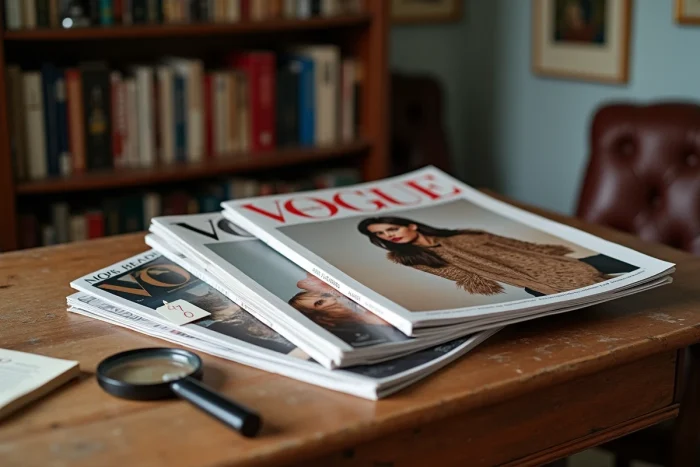
Counterfeits and Reproductions: Check Before Buying or Selling
The proliferation of AI image generation tools has created a real problem for buyers. Reproductions of vintage Vogue covers are circulating, imitating the texture of the paper, period typography, and photographic compositions with increasing realism.
For a buyer, several elements can help distinguish an original from a reproduction:
- Period paper has a texture, weight, and natural yellowing that recent prints do not faithfully replicate in touch.
- Pagination numbers, the quality of interior ad printing, and legal notices (publisher’s address, sale price) are difficult to consistently falsify throughout the magazine.
- Library stamps, subscription labels, or postal stamps provide authenticity clues that digital counterfeits do not generate.
Buying only from sellers who can provide detailed photos of the magazine’s interior (and not just the cover) remains the most reliable precaution. Specialized auctions in “fashion ephemera” at houses like Christie’s or Bonhams offer more guarantees than generalist platforms.
NFTs and Tokenized Covers: A Still Marginal Parallel Market
Since 2022, some publishing houses and auction platforms have begun offering iconic fashion magazine covers in tokenized (NFT) versions. Christie’s and Sotheby’s have announced sales of NFTs related to magazines, following similar operations on Time covers.
This market remains targeted and marginal. NFTs of Vogue have not replaced the demand for paper, but they create a distinct price category, disconnected from the physical condition of the copy. A NFT collector does not buy the same thing as a magazine collector: they acquire a digital certificate associated with an image, not an object.
For holders of rare physical issues, this evolution does not fundamentally change the game. The value of a collectible Vogue still relies on the combination of print run rarity, cover notoriety, advertising content quality, and, above all, impeccable condition.