
Choosing a pruning saw is less about the brand than about matching the guide bar, power source and intended cutting tasks. A poor match between bar length and motor power causes excessive vibration, premature chain wear and an increased risk of kickback.
Guide bar and chain speed: the technical balance to get right first
The guide bar length determines the maximum branch diameter that can be cut in a single pass. But a longer bar makes the tool heavier and shifts its centre of gravity forward, reducing manoeuvrability, especially on a pole saw.
As a rule, choose the shortest bar suited to the cuts you plan to make. For routine maintenance of fruit trees and ornamental trees, a 25 cm bar covers most needs. Beyond that, the increased cutting capacity comes at the cost of muscle fatigue and reduced precision.
Chain speed, measured in metres per second, determines how cleanly the saw cuts. A higher speed produces a cleaner cut that heals better—a point worth considering for species susceptible to pathogens. Professional models have significantly higher chain speeds than entry-level models, and the difference is noticeable from the first cuts. The specifications available on elagueuse-warrior.com make it easy to compare this feature across models.
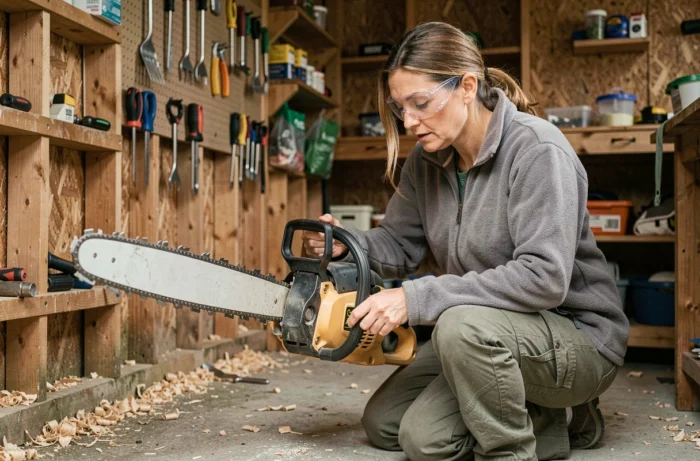
Top-handle pruning saw or pole saw: two tools for two types of work
Confusing these two categories is a common mistake. A top-handle pruning saw is designed for working at height, using a harness and climbing gear. In France, it is prohibited to use one from the ground. It is operated with one hand, which requires specific training and a secure anchor point.
A fixed or telescopic pole saw is used from the ground. It lets you reach high branches without climbing the tree or using a ladder. It is the right tool for homeowners who want to maintain their garden safely.
Fixed or telescopic pole
A fixed pole is more rigid and has less play while cutting, which improves precision. A telescopic pole lets you adjust the working height, but each additional section adds weight and flex.
- Fixed pole: best if the trees you need to maintain are roughly the same height and storage space is not an issue
- Telescopic pole: useful when cutting heights vary significantly from one tree to another, or when storage space is limited
- In either case, never use a pruning saw from a ladder, whatever the configuration
Petrol, battery or corded power: what really matters when choosing
The debate between petrol and battery models often comes down to perceived power. In practice, modern battery-powered tools can match small petrol engines for the cutting diameters typically encountered in a home garden.
Lithium-ion battery: runtime and voltage
Battery voltage (18 V, 36 V, 56 V) directly affects motor torque. An 18 V battery is sufficient for small-diameter branches. For regular cuts in hardwood, 36 V or higher is preferable. Runtime depends on capacity in amp-hours (Ah): the higher the figure, the longer you can work before recharging.
With no exhaust fumes, instant starting and lower noise levels, a battery-powered model is the obvious choice in residential areas.
Petrol: when it still makes sense
On large properties with thick branches, a 25 to 35 cm3 petrol engine still has the advantage of unlimited runtime and sustained torque over long sessions. The trade-offs are greater weight, engine maintenance (filter, spark plug, carburettor) and noise levels that may be unsuitable for close neighbours.
230 V corded: a niche option
A corded pole saw is best suited to small gardens close to a power outlet. The cable restricts movement and poses a cutting hazard if the work area is not clear. It offers good value for money, but becomes less practical as soon as you move away from the house.
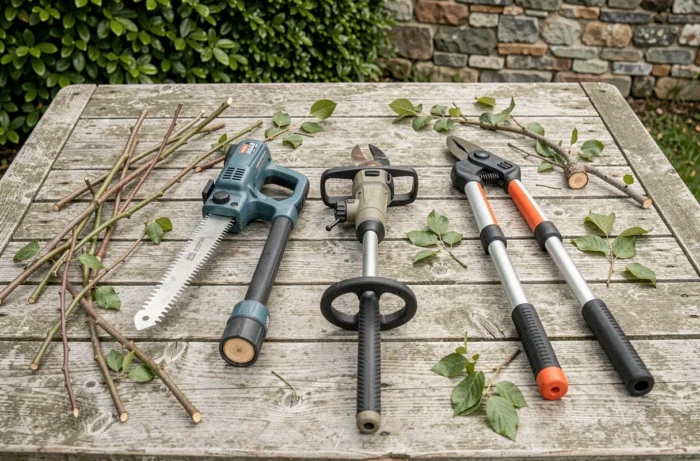
Pruning schedules and regulations to be aware of
Having the right tool does not exempt you from following the recommended schedule. The French Office for Biodiversity advises against pruning and trimming between 15 March and 31 July, when birds are nesting. For farmers, hedge trimming is prohibited from 16 March to 15 August under the CAP cross-compliance rules.
For homeowners, this is a recommendation rather than a legally binding prohibition. However, the presence of a nest belonging to a protected species may trigger specific obligations, including an immediate halt to work. To be safe, visually check branches before carrying out any spring pruning.
Another often-overlooked issue is proximity to power lines. If a tree is within a few metres of an overhead cable, you must contact the network operator or hire a suitably equipped professional to carry out the pruning. No pruning saw, however powerful, can eliminate the risk of electrocution.
Weight, balance and fatigue: factors that spec sheets don’t show
A poorly balanced lightweight tool can cause more fatigue than a heavier, well-balanced one. Trying it out is still the best way to assess how it feels in your hands. The weight listed in the specifications may not include the battery, bar and chain.
- Check the operating weight with the battery and bar fitted, not the bare tool weight
- Assess the centre of gravity: a motor positioned low on the pole reduces strain when working with your arms raised
- Check the anti-vibration system, especially if you expect to work for more than a few minutes at a time
- Choose a carrying harness for pole saws, even if the manufacturer offers it as an optional extra
Pruning puts strain on your shoulders, forearms and back. A tool that looks right on paper but feels uncomfortable in use will end up at the back of the garage after just a couple of outings. Operating weight and overall balance deserve as much attention as motor power or bar length.