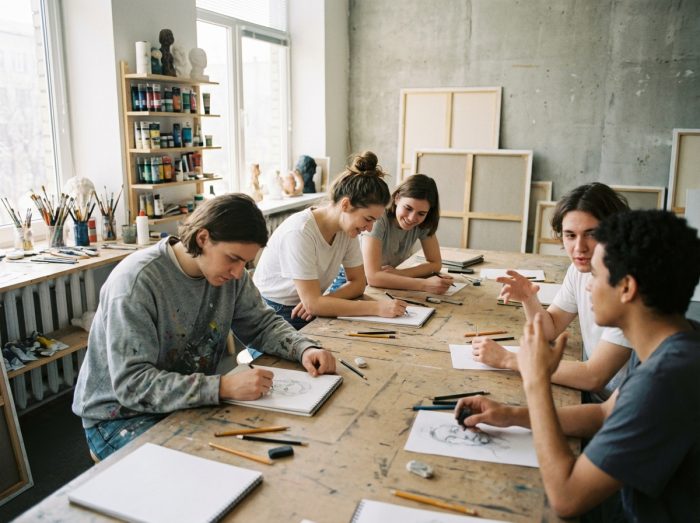
A figure circulates quietly: up to 40 hours of weekly presence, not counting hours of creation at home. This is the harsh reality that awaits every student in artistic preparatory school, far from the pastel images one sometimes has. The organization is precise, the demands are omnipresent, and uncertainty looms from admission, as a preliminary interview guarantees nothing, even with a good application.
The demanding program unfolds relentlessly: between theory, practical workshops, and collective projects, the week flies by without a break. Educational outings, far from being mere pauses, serve as real-life tests. To validate a semester, it’s impossible to neglect these field immersions or to skimp on one’s sketchbook: every detail matters, and everyone understands this from the first week. This new framework instantly shakes things up: the references from high school or university crumble, replaced by other demands, other rhythms, already tinged with professional orientations.
What does life in artistic preparatory school really look like?
The daily routine begins with a bang. Students quickly learn that the pace is nothing like school. Some arrive at the workshop while the city is still asleep, others linger for corrections or passionate discussions with professors, sometimes late into the evening. The challenge is not just to absorb lessons, but to dive into a continuous stream of creations and experiments. Endurance, both physical and mental, becomes another tool in the toolbox.
It’s impossible to build a portfolio by chance. Throughout the year, each student navigates between imposed constraints and the desire to bring forth new ideas. Drawing, volume, color, art history: these subjects do not line up like checkboxes, but serve as a springboard to understand, reinterpret, and appropriate their knowledge. Applied arts open the debate on what a project is: defending a vision, refining one’s viewpoint, transforming a concept into a tangible result. It quickly becomes clear that being autonomous does not isolate. On the contrary, everything happens within the group.
Collaborative work, public critiques, lively debates: it is in this collective effervescence that everyone reveals themselves, questions themselves, progresses, and refines their choices. Artistic preparatory school is experienced more as an emulation than as a solitary workshop. For those wishing to immerse themselves in this reality, an immersion in the daily life of students in artistic preparatory school provides a concrete and straightforward overview of what awaits those who commit to the field. Doubts, desires, fatigue, and the revelation of new impulses mark a decisive year for the future, in design, illustration, or animation.
Outings, workshops, and meetings: the immersive experience at the heart of the training
The learning field does not stop at the school gates. Throughout the year, the training is enriched with various opportunities. Here are some concrete examples of these cumulative experiences:
- visits to unexpected or lesser-known museums
- discoveries of major exhibitions, sometimes at the other end of the country
- immersions in cutting-edge galleries
- direct encounters with artworks and those who create them
Far from being anecdotal, these outings give depth to art history, help to put into perspective the relationships between artists, understand the breaks, and test audacity. Each visit leaves questions, references, fuels critical thinking, and nourishes personal practice.
Internally, the school pulses to the rhythm of collective workshops and concrete projects. Here, cooperation is not an empty word but a necessity: exchanging ideas, confronting constraints, testing and sometimes failing, is this process that allows one to grasp the backstage of graphic design, motion design, animation cinema, or decorative arts depending on the specialty. The teachers, often from the field, impart rigor, but also risk-taking and the flexibility of the creative mind.
The year is also marked by strong moments: conferences, round tables, exchanges with former graduates or recognized personalities. These meetings help to project oneself, give an idea of the diversity of paths, and show what awaits beyond preparatory school. This immersive dynamic changes the game: every opportunity, every contact with the outside, every project counts in building the future path.
Choosing your artistic preparatory school: what to know before enrolling
Deciphering the offer, probing the pedagogy
Choosing an artistic preparatory school cannot be limited to reputation or success rates. To find your way, you need to carefully examine the program, question the diversity of teachings, measure the daily support offered, and the space left for creation, both individual and collective. A serious structure harmoniously articulates practical workshops, real projects, and solid theoretical foundations in applied arts, graphic design, animation, or visual communication. To move forward methodically, here are some concrete points to check:
- plan a visit to the premises and a direct exchange with the teachers
- ask to browse several books or portfolios created by students who have passed through the preparatory school
- inquire precisely about the prospects in art and design professions
- observe the results of former students in the entrance exams
Preparing your portfolio: an essential step
The artistic portfolio is a central piece that requires sorting, presenting intelligently, and carefully choosing the works. It gathers personal works, a letter detailing the journey, and often an interview with the jury. The goal: to highlight the richness of one’s approach – drawing, volume, visual experiments, and to prove that one knows how to delve into a theme, follow through on ideas, and commit to a demanding project. Time and again, it is this unique perspective, coupled with a willingness to transform constraints into creative resources, that juries seek to detect in candidates.
Looking beyond the year
The year in artistic preparatory school is not an end in itself, but a springboard. From the start, one must project themselves: the opportunities in art schools, animation, game design, or graphic design need to be examined closely. Alumni networks, feedback, and post-preparatory trajectories help to adjust one’s project. The more coherent the choice of training, the richer the future looks.
Some continue in the most prestigious institutions, while others shape their own path in creation. But all leave with the same imprint: a dense year, sometimes exhausting, that pushes one to reinvent themselves. Fatigue leaves its marks, as does the momentum. And it is not uncommon for a sketchbook, opened one early morning, to become the starting point for an entire future.