The number of enrollments in specialized schools for 3D animation has doubled in ten years, according to figures from the CNC. This growth far exceeds that observed in other artistic or technical fields.
The job market in 3D animation has lost none of its vigor. Job offers are flourishing, global competition continues to gain ground, and yet, every year, recruiters raise their expectations. Joining these programs requires obtaining one’s ticket through a selection process where rigor prevails over approximation.
3D Animation, a fertile ground for new creative generations
Parisian studios, communication agencies, video game companies: all are on the lookout for profiles capable of mastering modeling, inventing in VFX, or producing for audiovisual media. Opportunities have never been so numerous: animated films, video games, architectural videos, series, advertising… In five years, French animation production has jumped by 36%, so the sector continues to attract enthusiasts across the country.
Companies in the sector are looking for much more than good technicians. Today, they seek professionals capable of innovating, collaborating, and breaking the codes to invent new narratives. The major challenges of VFX, animated creation for cinema and advertising, or video games require constant reinvention. It is in this context that 3D animation schools for image enthusiasts stand out for their ability to combine cutting-edge technical training with a culture of creativity. Just browsing through student works reveals how technology and invention advance hand in hand, elevating French production.
France is establishing itself as one of the major hubs of international 3D animation: expanding studios, large-scale projects, massive recruitment… Paris, as well as Lyon, Lille, and Montpellier, have become strongholds of employment. The possibilities are numerous, from independent studios to large advertising agencies, including architectural video and production houses. A vast playground for diverse profiles ready to seize their chance.
Skills and professions: the spectrum widens in 3D animation
This sector attracts those who want to combine artistic flair with technological expertise. On the ground, each specialty refines its requirements. Some opt for art direction, relying on their sense of image and storytelling. Others prioritize modeling or VFX, where patience and visual acuity are the cornerstones of the profession.
In studios, the creative chain stretches from game design to final rendering supervision, passing through the management of ambitious projects. Orchestrating multiple teams, adhering to a tight schedule, and providing a coherent graphic vision: these are the challenges faced by project managers and art directors.
Several key roles are found in the market:
- 3D Modeler: sculpts characters, objects, and worlds, giving them presence on screen.
- Animator: injects movement, modulating each gesture and sequence.
- Art Director: defines the visual style, overseeing the overall graphic identity.
- Project Manager: coordinates production, leads teams, ensures timely delivery.
Beyond mastering software, one must go further: absorb production methods, integrate into complex workflows, demonstrate a strong visual culture, and know how to communicate. The range of fields involved, from cinema to architecture, from video games to digital advertising, demands flexibility and openness. Here, those who can juggle styles and anticipate changes quickly gain value.

Training that opens doors to the sector: BTS, master’s degrees, and specialized schools
Engaging in a training program dedicated to 3D animation means accepting challenges and pushing boundaries. Each school fine-tunes its curricula according to profiles: some embark on a BTS in graphic design for a quick entry into the profession, while others extend their journey to deepen their style and prepare for design roles. Major cities are seeing a growing number of professional courses, marked by internships and workshops supervised by professionals who work in the field daily.
Regarding admission procedures, it relies on the presentation of personal works, a portfolio, or a sketchbook, sometimes based on success in a selective competition. Depending on each individual’s project, choices are available through several pathways:
- A BTS to quickly discover the sector’s requirements right after high school
- Bachelor’s or master’s degrees to go further, gain experience, and aim for responsibilities
- Programs focused on video games, VFX, graphic design to develop targeted expertise
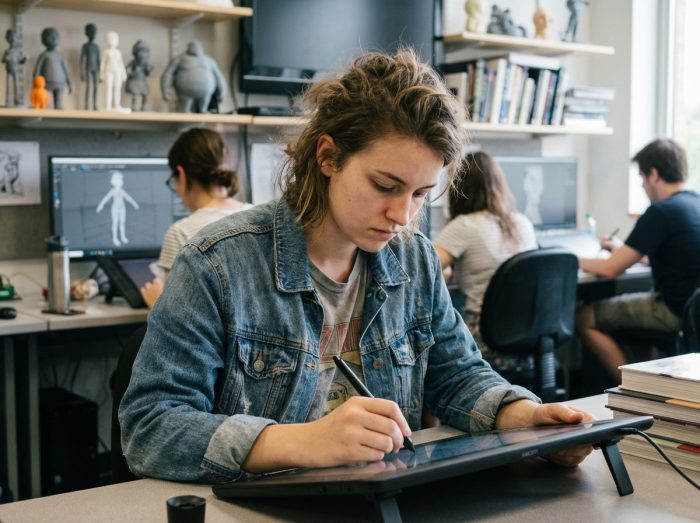
The pedagogy emphasizes experimentation on real projects and individualized support. Students build their progression from initial modeling to the creation of animated scenes, utilizing a range of tools commonly used in companies. For some, the reputation or partnerships established with studios facilitate the first contracts and entry into the market. The admission calendar varies, with some starting right after high school, while others begin after a diploma in applied arts or graphic design.
Within the schools, the atmosphere sometimes resembles that of a studio: project groups, crisis management discovery, simulations of real orders. Everyone refines their habits, measures their ability to bounce back, and gradually shapes their path. Between personal ambition, curiosity, and the desire to make a mark in animated imagery, all come here to pave their way into an expanding sector, and for many, the prospect of participating in creations that will make history in the coming years.