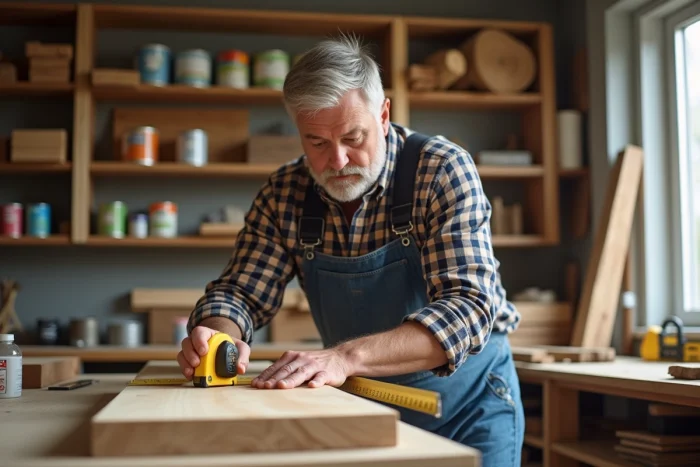
A poorly positioned tape measure skews a cut, even on a simple project. Some glues prove less effective on modern materials than advertised on their packaging. Universal screws, often recommended, do not always provide the best hold depending on the substrate used.
Despite the abundance of tutorials, each task contains its pitfalls, and the accumulation of small mistakes can compromise the final result. However, a few precise gestures and thoughtful choices are enough to ensure durable results.
Why home DIY is attracting more and more people
Once limited to a few enthusiasts, DIY now brings together a much broader audience, driven by the wave of DIY (Do It Yourself). Whether it’s rearranging a shelf, refreshing a terrace, or designing a flower box for the balcony, each project becomes an opportunity to express creativity and assert autonomy. Today, DIY is present in every room, including the garden, terrace, or balcony.
Among the reasons for this appeal are the need to personalize one’s interior, the desire to develop skills, and the wish to quickly feel the personal satisfaction of a completed project. Doing it oneself means choosing to learn and create without waiting. The economic aspect is not to be overlooked: repairing rather than throwing away, repurposing an item through recycling or upcycling, helps reduce expenses while limiting waste.
The experience of DIY does not stop there. Immersing oneself in a hands-on activity, focusing on a concrete task, and seeing the result take shape before one’s eyes all nurture self-confidence. Many take these moments to pass on to their children the curiosity of “doing” and the satisfaction of a job well done. Others find their place within the DIY community: mutual aid, sharing advice, and mutual inspiration. In this regard, ohbrico.fr stands out as an essential resource, offering varied and reliable content suitable for all levels.
It is impossible to ignore the environmental dimension: the recycling of materials, the transformation of discarded objects, and the creation from local resources are now part of common practices. Home DIY thus becomes a collective commitment, balancing asserted autonomy, the search for meaning, and respect for natural resources.
What are the common pitfalls to avoid when starting a DIY project?
Haste is a poor advisor. Jumping into a DIY project without method or preparation exposes one to a whole series of missteps. Among the most common mistakes is the desire to rush: neglecting space organization, forgetting to check available materials, or skipping the list of necessary tools. Taking the time to develop a clear plan, gathering basic tools such as a hammer, screwdriver, saw, drill, pliers, tape measure, and level, structures the work and limits surprises.
Do not overlook safety. Wearing gloves, protective glasses, and sometimes a mask depending on the task is not a luxury but a necessity. Often relegated to the background, protection is crucial for the smooth progress of the entire project. The instructions for power tools deserve careful reading, even for operations that seem obvious.
Another frequent mistake is underestimating the preparation phase. Measuring precisely, marking, anticipating the placement of each element, and checking the compatibility of chosen materials are all reflexes to adopt. Drawing a diagram, even a rough one, helps clarify the approach and avoid last-minute corrections. Accepting that learning involves small setbacks allows for progress without discouragement. DIY is also a matter of perseverance, a succession of trials and adjustments.
To progress more smoothly, several solutions exist:
- Consult online tutorials to visualize each step and gain autonomy
- Join a DIY community to benefit from shared advice and tips
- Ask the opinion of friends experienced in manual work
This sharing of experiences, far from being secondary, enriches practice and strengthens the confidence of budding DIYers.

Concrete tips for easily succeeding in your first DIY projects
To start, nothing beats accessible projects. For example, making a wall shelf from raw wood, transforming a simple jar into a pencil holder, or giving new life to a forgotten piece of furniture with a coat of paint. These projects allow you to get comfortable with tools, familiarize yourself with the material, and personalize your interior without taking risks.
Wood is the ideal ally for beginners. Easy to cut and assemble, it lends itself to a multitude of creations, from rustic stools to coffee tables made from reclaimed pallets.
Before starting, a well-organized workspace is essential: prepare a tape measure, a level, a drill, and suitable gloves. Taking the time to measure, anticipate assemblies, and prepare each step is key to the success of the whole.
To progress, several resources are just a click away: draw inspiration from online tutorials, browse specialized books, or explore the advice of members of the DIY community. Enthusiastic amateurs like Christian Pessey or certain creators willingly share their tips for overcoming difficulties and varying approaches.
Recycling and upcycling also open up new horizons: transforming a pallet into furniture, repurposing a bottle into a vase, giving a second life to everyday objects. DIY is also about joyful creativity, valuable for decoration but also for designing a garden, balcony, or terrace. Sharing the activity with family, especially children, multiplies ideas and creates memories while developing useful skills for everyone.
Ultimately, each DIY project bears the mark of those who envisioned it. At the end of the day, the entire house is transformed, piece by piece, gesture by gesture.