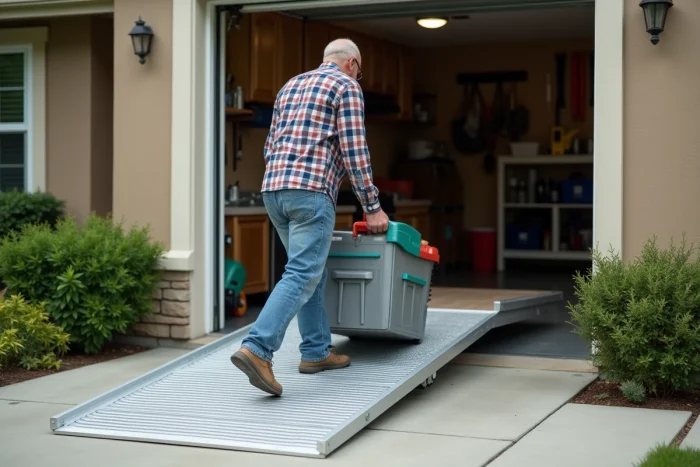
The use of unsuitable equipment to move heavy materials remains one of the main causes of accidents during home improvement tasks. Despite the variety of solutions available, most individuals continue to favor improvised methods, which are often ineffective and risky. In the face of rapidly evolving DIY needs, choosing a safe and functional device has become a technical necessity, not just an option.
Some models available on the market meet strict standards, often overlooked by many, while their adoption can significantly reduce effort and risks during handling. The selection criteria and associated benefits deserve special attention to avoid costly mistakes.
What is a loading ramp used for in your DIY projects?
The loading ramp is far from a trivial accessory. To move materials, lift a full wheelbarrow, or load a motorcycle into a trailer, it transforms a chore into a controlled action. Thanks to it, the transition from the ground to a platform or utility vehicle is done effortlessly and safely, away from perilous improvisations. Protecting your back, conserving your energy, and reducing breakage are what this discreet yet remarkably effective ally allows. The equipment quickly becomes essential for anyone looking to do DIY without inflicting fatigue and unnecessary risks on themselves.
The loading ramp is used to safely overcome level differences. It eliminates the obstacle of workshop thresholds, bins, or trunks, and becomes indispensable whenever it comes to transporting bulky or heavy loads. DIYers, craftsmen, and gardeners know: handling a lawnmower or removing debris becomes much simpler, and above all, safer. In this regard, Brico Dépôt loading ramps on Côté Déco provide a concrete solution designed to limit unforeseen events and ensure stability and safety with every maneuver.
Depending on the needs, the loading ramp comes in various forms. For a lawnmower, an ATV, or a wheelbarrow, a robust, non-slip ramp suited to the size of the object being moved is required. In daily use, it quickly becomes a valuable ally for loading materials, transporting furniture, or disposing of waste without putting oneself in danger. It structures the workspace, streamlines logistics, and allows each stage of the project to be approached methodically, where improvisation too often leads to breakage or injury.
Focus on the different types of ramps and their specific uses
There is a true diversity of loading ramps, each designed to meet specific contexts, at home as well as on the job site. Folding ramps are appealing due to their practicality: they are easy to transport, can be stored in a corner of a garage or the back of a vehicle without taking up space. Aluminum, lightweight and sturdy, predominates in this type of model, perfect for those seeking mobility without sacrificing strength. Conversely, fixed ramps provide unwavering stability: they withstand repeated passage of heavy loads, ideal in a workshop or for intensive use.
The choice of material is crucial. Aluminum facilitates handling, while galvanized steel or reinforced plastic alloys offer robustness against wear and heavy loads. On the safety side, the non-slip surface, whether ribbed, grooved, or perforated, makes all the difference, especially outdoors or in the rain. This detail prevents many slips and maintains the effectiveness of the device, even after numerous uses. Models with ribbed bridges or perforated surfaces also limit the accumulation of dirt or debris, reducing maintenance and extending their lifespan.
Here are the main types of ramps encountered and what they offer:
- Car ramp: perfect for overcoming a small threshold or loading a light vehicle effortlessly.
- Telescopic ramp: its variable length makes it useful for unexpected heights or changing situations.
- Mobile ramp: easy to move, it adapts to different workstations or occasional needs.
There are also accessories to complement everything: ramp supports to ensure stability, or ladders for safe work at height. The loading ramp then fits into a logic of adaptation, to the configuration of the location, the type of load, and the frequency of use. It’s not just a matter of comfort; it’s a matter of safety and efficiency in every intervention.

What criteria should be considered when choosing a loading ramp?
To choose a loading ramp well, it is not a matter of relying on chance or the lowest price. Several technical criteria should guide your decision to avoid unpleasant surprises. Start with the load capacity: an undersized ramp risks deforming or even failing, which would jeopardize everyone’s safety. Always check the maximum weight the ramp must support, whether it’s a vehicle, construction machinery, or a wheelchair. The length of the ramp also influences the incline to be climbed: the longer the ramp, the less steep the ascent, which reduces the effort required and limits the risk of slipping, especially for domestic or frequent use.
Width is not a detail. It must allow easy passage of the equipment used, whether it’s a lawnmower, wheelbarrow, scooter, or even wider machinery. For a user in a wheelchair, a comfortable width and a non-slip surface are essential, especially in wet weather. Opt for ramps with ribbed or perforated surfaces to maximize grip and avoid accidents during repeated or intensive use.
When choosing, keep the following points in mind:
- Adjustable height: change levels easily, ideal if you are working on various types of thresholds or platforms.
- Secure fastening system: the ramp must remain perfectly in place during passage, hence the importance of a fastening suitable for your work environment.
- Regular maintenance: checking the condition of the ramp extends its lifespan and maintains an optimal level of safety with each use.
Finally, adapt the choice of material to the environment. For outdoor use, opt for materials resistant to corrosion, such as aluminum or galvanized steel. Taking the time to compare these parameters ensures that you use a reliable loading ramp that truly meets the needs of the field and sustainably supports all your projects.
On the ground, the efficiency of a project also relies on these technical details. A well-chosen loading ramp not only saves time: it prevents issues, protects health, and transforms each handling operation into a controlled routine. DIY sometimes plays out in silence, between regained safety and preserved energy.