
Manufacturers often impose a limit of 40,000 pieces, but this rule has been surpassed several times over the decades. Since 2011, records have fallen in a race among international brands, student associations, and giant assembly enthusiasts.
The number of pieces, the area covered, or the assembly time fuel a competition where creativity is expressed as much as patience. Behind each record, unexpected figures and unique anecdotes testify to a global fascination for these extraordinary challenges.
When puzzles become giants: a fascinating and little-known story
The puzzle has conquered our tables and living rooms, but its origin holds many surprises. In 1766, it was an English cartographer, John Spilsbury, who had the idea to cut the world map into pieces: each continent becomes a piece to be placed back, to help children learn geography. This inaugural gesture is not limited to amusement; it carries the will to educate, to transmit, and, already, a hint of intellectual challenge.
Over time, France and Europe saw the proliferation of variants and uses. The 19th century celebrates the age of wooden puzzles, a noble and patient piece, while the 20th century democratizes machine-cut cardboard. But behind mass production, a few stories stand out. Thus, Rachel Page Elliott designed the most expensive puzzle ever sold: 467 wooden pieces auctioned for 27,000 dollars at a charity sale. Here, prestige does not lie in the number, but in rarity and collectible value.
In recent years, excess has entered the discipline. In China or Vietnam, records are regularly broken by entire groups of students, associations, and sometimes artists. This collective passion gives rise to challenges that unite crowds and leave a mark. To learn all about the largest puzzle in the world, one must navigate through historical anecdotes, team exploits, and staggering figures. From an educational tool, the puzzle has become a cultural icon, reflecting a taste for patience, meticulousness, and embraced complexity.
What are the largest puzzles in the world and their record figures?
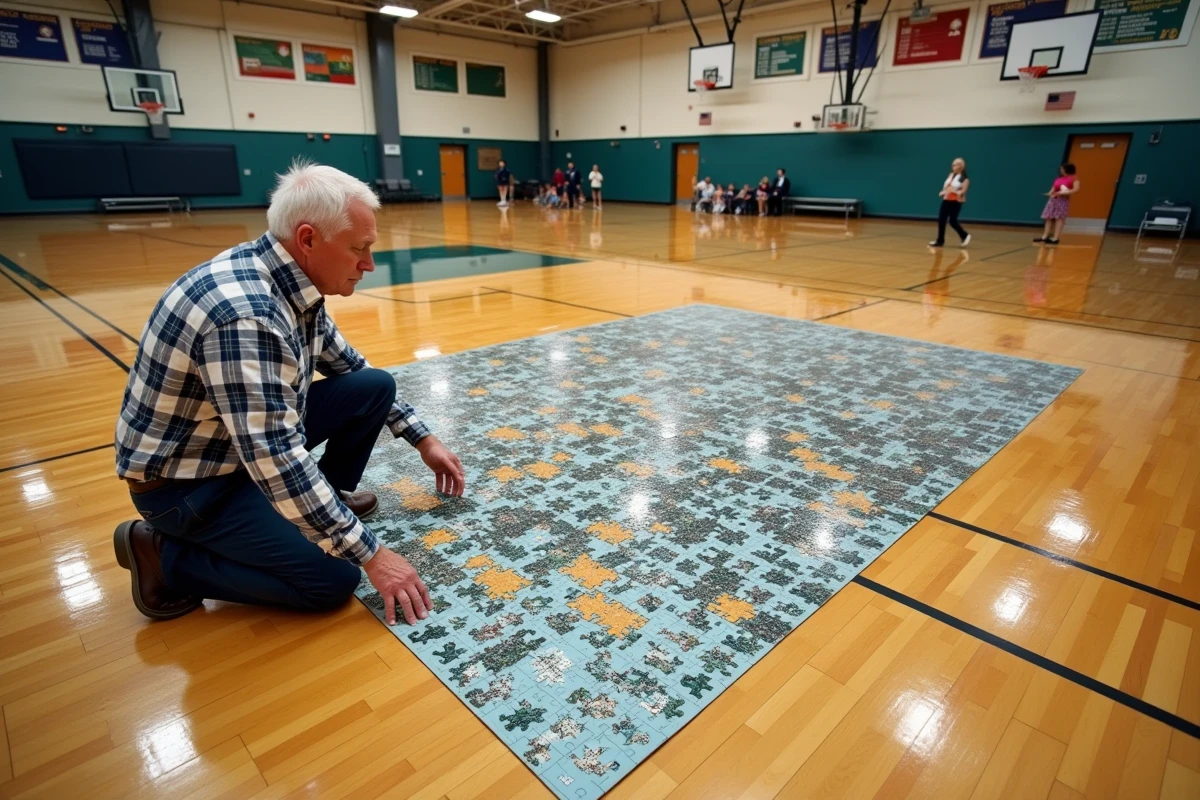
If we look at world records, some figures are mind-boggling. In Vietnam, in 2011, 1,600 students from Ho Chi Minh City University of Economics gathered to assemble a monumental mural. The result? 551,232 pieces that, once assembled, depict a six-petal lotus flower. This collective project earned a place in the Guinness World Records and embodies the festive and unifying dimension of the giant puzzle.
Another record took place in Dubai, but this time, it is the area that impresses more than the number of pieces. With 13,320 elements spread over 6,122 m², the puzzle becomes a terrain to conquer, to be admired from afar as the image unfolds in public space. One no longer simply assembles pieces; one shapes a landscape on the scale of a stadium.
Some publishers also offer boxes that defy imagination. Here are some notable examples:
- Travel Around Art: 54,000 pieces, assembled by Didier Delorme and displayed at the Château de Girard in Mèze
- Animal Collage: 52,110 pieces
- Around the World (Kodak): 51,300 pieces
These massive puzzles fascinate as much for their titanic content as for the time it takes to complete them. Each box resembles a long-term project, sometimes shared among friends or family.
There is also the particular case of the largest hand-cut puzzle: 101,010 pieces, 22 meters long, made of MDF by Jill Walterbach. A handcrafted achievement that shows that patience and meticulousness are not reserved for machines. As for the largest puzzle collection, it consists of 1,260 pieces, gathered by Khloud Abo Zayda, a lifetime dedicated to collecting and assembling, piece by piece.
Anecdotes, exploits, and passion: what extraordinary puzzles reveal
Behind these exploits, there are human stories, faces, and tales of tenacity. Among enthusiasts, certain names recur like living legends. Didier Delorme, for example, took on the famous Travel Around Art of 54,000 pieces, assisted by Fabien Helmer. A labor of love that requires method, perseverance, and flawless organization, not to mention the pleasure of watching the image gradually emerge from this ordered chaos.
Another example of prowess is Hans-Josef Schaadt, who managed to assemble the same puzzle in just 99 days. The challenge seems insane: each piece must find its place, each pattern must match, and the slightest mistake can cost hours of reflection. In the category of pure speed, Sarah Mills broke the record for the 1,000-piece puzzle in 1 hour and 40 minutes during the British Championship 2020, while Alejandro Clemente León completed 500 pieces in 34 minutes and 25 seconds. Here, everything is a matter of extreme concentration and precise movements, leaving no room for improvisation.
Collective exploits, on the other hand, play out on other stages. In Barcelona, 9,569 participants joined forces to assemble the largest collective puzzle ever made. And then, there is the enigmatic Eternity II, conceived by Christopher Monckton: this puzzle promised a reward of two million pounds to whoever found the solution. More than a game, it was a mathematical challenge, a riddle designed to resist human logic. The puzzle, in its extreme version, thus becomes a terrain of invention and boldness, an invitation to go ever further.
In the face of these figures, these stories, and these exploits, we understand that the largest puzzle in the world is not only measured in pieces or square meters. It is also made of challenges met, memories shared, and that quiet patience which, at times, moves mountains.