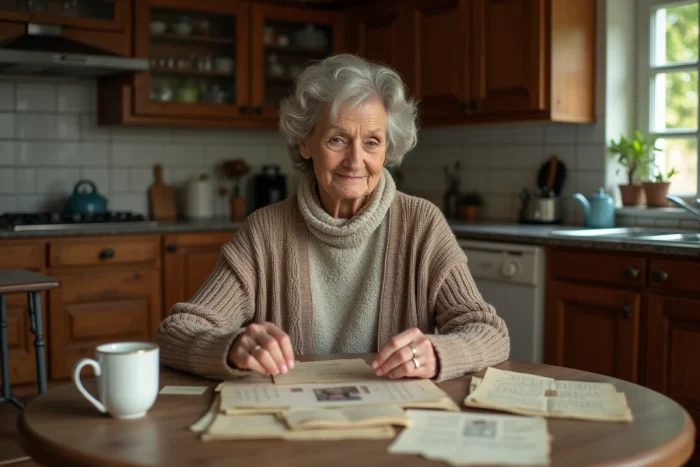
A name inscribed with a pen in an old register, a forgotten date scribbled in the margin of a death certificate: family history is often written far from laboratories and test tubes. Long before DNA kits and genetic promises, entire families traced their lineage through dusty archives, stories passed down in whispers, or surnames that appeared where they were least expected. It is here, in the intertwining of documents and memories, that the most surprising connections sometimes hide.
Why searching for your origins without DNA testing remains fascinating and accessible
Exploring your roots without going through the laboratory is about reconnecting with the human dimension of family history. Instead of DNA files and algorithms, it involves listening to the memories of the elders, flipping through that yellowed album or that memory book passed down from one generation to the next. Many choose this path: it preserves confidentiality, respects everyone’s privacy, and keeps commercial logic at bay. In France, the regulation on genetic testing is clear: parentage is never reduced to a question of genes or “ethnic” labels. Certain situations, such as adoption or birth under X, also benefit from the support of the National Council for Access to Personal Origins (CNAOP), which guarantees rights as well as respect for life journeys.
For those who refuse to entrust their stories to databases, alternatives exist: collecting and organizing personalized books, creating a memory box, gathering photos, stories, and administrative traces. Reclaiming one’s family and ethnic origins through the patient quest for documents reveals unexpected connections and allows for lived experiences, shared narratives, and respect for privacy. For more concrete leads, you can read on Conseils Parentaux.
What resources to explore to trace your family history?
Tracing the trail of your ancestors often begins in the vast universe of archives. National, departmental, or municipal services house treasures: civil status records, births, marriages, deaths, and, for older periods, parish registers. For those whose families have overseas or foreign origins, the ANOM or SCEC in Nantes open up other horizons.
Consulting notarial acts, sifting through censuses, studying an old family booklet: each document completes the picture and outlines sometimes unsuspected trajectories. The confrontation between religious registers and civil status archives gives substance to parentage and sheds light on family paths. With digitization, a large part of this research can now start from your computer.
To move forward in a structured way, here are effective tips:
- Turn to local genealogy associations to benefit from collective experience and unique resources.
- Familiarize yourself with a genealogy software to connect generations and avoid getting lost in the abundance of information.
- Meticulously examine family documents: letters, notebooks, school reports, captioned photos, which often hold surprises.
For families affected by adoption or birth under X, the adoption service and other public organizations provide useful support with civil registries. With each name found, with each document deciphered, the thread of generations is rewoven, each discovery adding its stone to the family edifice.

First concrete steps: practical tips to start your genealogy simply
Before stepping into a town hall or opening an archive site, start by gathering your extended family around you. Parents, grandparents, aunts, cousins: each holds a piece of the puzzle. Take the time to record first names, which may vary significantly from one document to another, key dates, places of birth, marriage, death, and don’t forget the anecdotes that color each biography. The family booklet remains a reliable starting tool for drawing a solid family tree.
Next comes the confrontation stage: comparing family information with civil status records obtained from the town hall or through digitized archives. The departmental archives provide long series of birth, marriage, and death records. Don’t underestimate the variation in surnames or the repetition of witnesses: these clues sometimes open the way to forgotten branches.
Some tips to get off on the right foot:
- Choose a genealogy software to visually represent and organize the evolution of your family.
- Explore censuses and notarial acts, which are very useful for discovering hidden siblings, address changes, or forgotten professions.
- Rely on genealogy associations that provide tools, support, and field expertise.
An apparently trivial detail in a memory book, a letter from the past tucked away in an old box, or the story of an ancestor: every little clue can transform the understanding of your roots. Genealogy, far from being reserved for seasoned researchers, requires above all perseverance, attention, and the desire to connect each anecdote to a face or a story.
Continuing the quest means accepting to sometimes move forward hesitantly, between revelations and silences. A piece of archive that has emerged from oblivion is often enough to bring an entire generation back to life. Through each branch found, each annotated photo, a whole part of the past comes alive, ready to be shared, questioned, and passed on.